Worcester Tree Trim and Removal
Menu
Cracked Foundation? How Tree Removal Can Help
Tree Removal Worcester
Many homeowners in Worcester are unaware that foundation cracks they have found in their home may be caused by a mature tree that was planted on or very close to the house many years ago. This is common in older neighborhoods of Central Massachusetts (surrounding The College of the Holy Cross), as well as in those located near parks such as Green Hill Park. Over time, tree roots can quietly weaken the integrity of a home’s foundation, causing costly structural problems that will need to be repaired by removing the offending tree and repairing the foundation. By understanding how tree roots can cause damage to foundations in homes in Central Massachusetts, local property owners can make informed choices for protecting their largest investment.
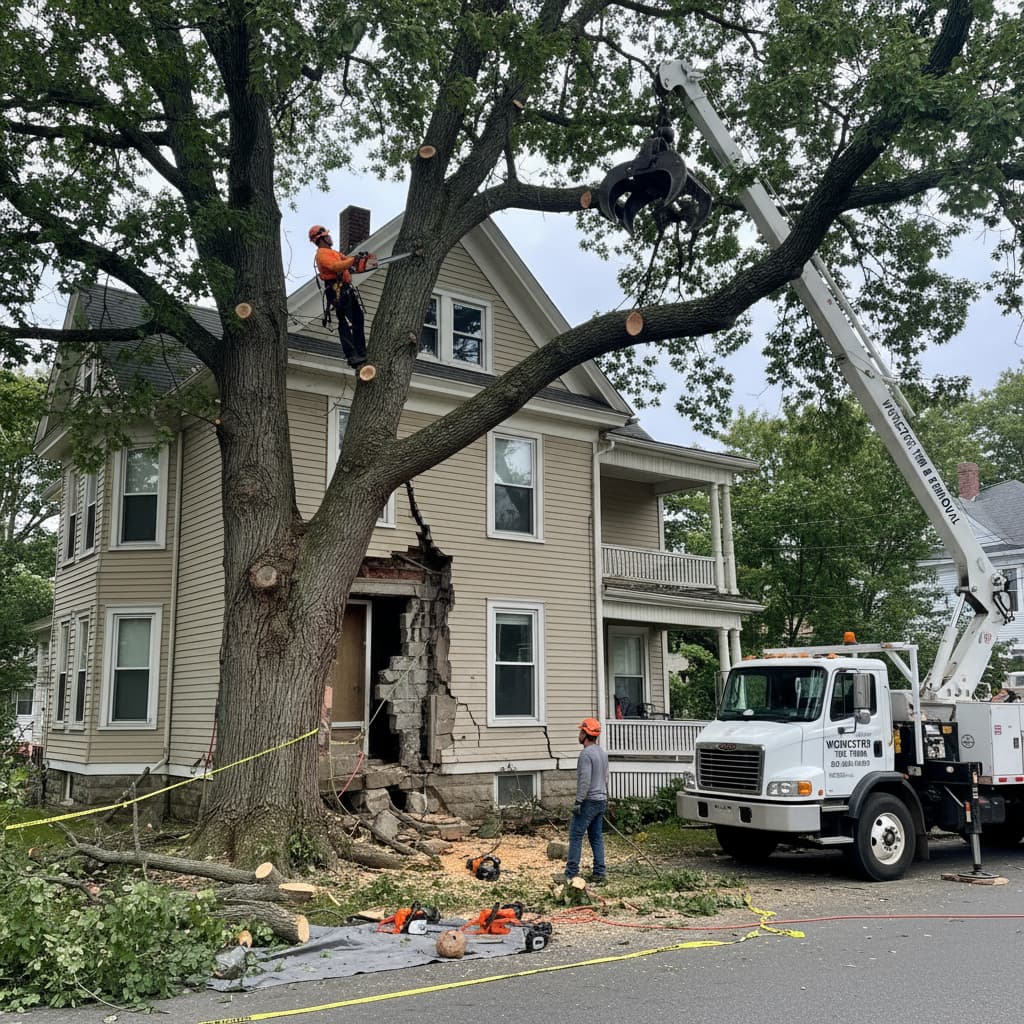
Understanding Tree Root Foundation Damage
Understanding how tree roots damage foundation structures is essential for identifying and preventing costly structural damage to your home. Tree roots can cause foundation damage through several different mechanisms that can occur gradually, which can make it difficult to notice problems before they become major structural damage.
How Tree Roots Damage Foundations
Typically, large tree roots do not penetrate solid concrete foundations but instead take advantage of pre-existing weaknesses, such as small cracks, settling joints, or defects in the construction process to locate a source of moisture on the inside of a foundation wall. After gaining entry, tree roots grow and shrink with the changing levels of moisture in the soil during each season and slowly widen any cracks in the wall and weaken its structural integrity.
More commonly, tree roots can damage foundations by altering soil conditions around a building. Mature trees use an enormous amount of water from the soil around them, creating “dry” zones in the soil that cause clay soils to shrink and settle. Worcester’s glacial clay soils are highly susceptible to this type of movement and, therefore, create uneven settling (differential settling) that can create cracks in a foundation and structural instability.
As a result of tree roots growing into the soil adjacent to a building, they create pressure on the foundation walls as the roots expand. Lateral roots from hardwoods, such as oak, maple, and other hardwoods native to Worcester, are capable of producing thousands of pounds of pressure on basement walls, creating bowing, cracking, and water leakage into a basement.
Most Common Species That Pose a Problem
Properties located in Worcester frequently contain tree species with aggressive root systems that have a high propensity for damaging foundations. Silver Maples, American Elms, and Willow trees all produce extensive shallow root systems that can extend far beyond their canopy and can reach a foundation wall 50-100 feet from the tree trunk.
Oak trees are very common in the Crown Hill-Piedmont area and other established Worcester neighborhoods and possess both a deep taproot and an extensive lateral system that can damage foundations either through contact with the root system or through the reduction of available soil moisture.
In addition to the fact that Norway Maple trees are frequently planted as street trees throughout Worcester, their root systems display particularly aggressive behavior to locate moisture sources and exploit weaknesses in foundations. Additionally, the shallow, dense root mat of a Norway Maple can lift sidewalks, driveways, and foundation slabs, while also reducing soil moisture available to support the walls of a foundation.
Identifying Signs of Root-Related Foundation Damage
The earlier you identify root-related foundation problems, the sooner you can begin taking steps to address them before they need extensive structural repairs or emergency tree removal services.
Interior Signs of Potential Root-Related Foundation Damage
Often, signs of root-related foundation problems appear first as minor interior symptoms that gradually increase over time. Hairline cracks along a basement wall, particularly near windows or where a foundation wall meets a floor, may indicate root pressure or soil movement caused by a nearby tree.
Sticky or binding doors and windows, or failing to close properly, often indicate that a foundation is settling due to the fluctuating levels of soil moisture caused by large tree root systems. The likelihood of experiencing these symptoms increases during dry periods when trees absorb as much moisture from the surrounding soil as possible.
Separation of trim work, uneven floors, and cracks appearing at the corners of ceilings may indicate differential foundation movement caused by tree roots. Older homes in Worcester, particularly those constructed prior to modern foundation techniques, are more likely to experience these symptoms than newer construction.
Exterior Signs of Potential Root-Related Foundation Damage
Significant indicators of potential root-related damage can be identified by visually inspecting the exterior perimeter of a building. Cracks in foundation walls, particularly horizontal cracks or step-patterned cracks following mortar joints, can indicate lateral pressure from expanding root systems.
Water accumulation in basement window wells or evidence of soil settlement near the well may indicate root activity that has disrupted the normal drainage pattern around a foundation. Trees can damage the drainage systems of foundations, creating moisture problems that exacerbate structural damage.
While less frequent, bulging or bowing foundation walls can be an indicator of serious root-related damage that requires prompt attention. These conditions may develop over years, but can quickly accelerate once the structural limitations of a building have been compromised.
When Is Tree Removal the Best Option?
Determine whether tree removal is the best option for addressing root-related foundation problems involves evaluating the overall health and root system of the tree, the degree of existing damage to the foundation, and the potential for future damage.
Risk Level Based on Distance
Trees planted within 20 feet of a foundation wall represent an increased risk of root-related damage, especially for species with large canopies such as oak, maple, and elm. However, the proximity of a tree to a foundation does not necessarily define the risk; root systems can extend two to three times the diameter of a tree’s canopy, potentially causing foundation damage at great distances.
Age and Construction Methods of the Foundation
The age of a foundation and the materials used in its construction play a role in determining its susceptibility to damage caused by tree roots. Homes in Worcester built prior to 1950 may lack the modern moisture barriers and reinforcement methods that help protect a foundation from root intrusion and soil movement.
Local Soil Conditions
The type of soil that surrounds a building influences both the pattern of root growth and the stability of the foundation. Clay soils that shrink greatly during dry periods provide optimal conditions for root-related foundation movement, whereas sandy soils may permit root systems to grow and exert pressure on a foundation without generating similar amounts of force.
Measuring the Degree of Existing Damage
Small cracks in a foundation measuring less than 1/4 inch in width and indicating little to no movement may not require immediate removal of a tree, especially if the tree provides a significant landscape benefit or contributes to environmental values. By monitoring the rate of crack progression during various seasonal cycles, you can determine if root activity is continuing to contribute to the degradation of a foundation.
If you have experienced progressive damage to a foundation, including widening cracks, new crack development, or indications of water leaking into a foundation, then you probably have an ongoing issue related to root activity that will only be resolved when the tree is removed. These situations typically require homeowners to search for tree removal near me to find qualified professionals who can prevent further foundation deterioration.
Emergency tree removal services are usually able to respond promptly to emergency situations where a foundation is at risk of catastrophic failure, or is experiencing significant movement, or there is substantial water leakage into a foundation. Emergency tree removal service providers are often able to perform the necessary work in 24-48 hours.
Alternative Solutions Compared to Tree Removal
Homeowners experiencing root-related foundation damage can consider several options based on the value of a tree, the degree of existing damage, and their plans for their property.
Installing a Root Barrier
A root barrier can be installed to divert the root growth of an existing tree away from a foundation, thereby allowing the homeowner to retain the value of the tree while protecting the foundation. Plastic or metal barriers are placed two to four feet below grade and deflect the roots downward, rather than laterally toward the foundation.
However, root barriers are most effective as preventative measures for trees that are not yet causing damage to foundations. Established root systems of a tree near a foundation may already have caused some damage that will continue to deteriorate regardless of a barrier being installed.
The cost of installing a root barrier is generally comparable to the cost of removing a tree, and the effectiveness of a root barrier may be questionable over the long term. A large mature tree may eventually grow past a barrier, or the roots of the tree may continue to grow beyond the edges of the barrier and affect the foundation.
Pruning Selective Roots
Professional pruning of specific roots can remove the roots responsible for the damage to a foundation while allowing the homeowner to retain the value of a tree that provides significant environmental or aesthetic benefits. This method is most effective for trees with localized root intrusion rather than widespread root systems that impact large portions of a foundation.
Careful consideration must be taken when selecting roots to prune, to ensure that pruning does not compromise the structural stability of the tree. Removing too many roots can make a tree unstable during extreme weather events or cause a slow decline that ultimately leads to the necessity of removal.
Success rates for selective root pruning vary widely based on the species of the tree, the age of the tree, and the extent of the development of the root system. A certified arborist can evaluate if selective pruning represents a viable alternative to complete tree removal for a particular situation.
Benefits of Complete Tree Removal
Removing a tree provides a permanent solution to root-related foundation problems, removes ongoing risks of future damage, and enables comprehensive repair of a damaged foundation. Removal also eliminates ongoing maintenance costs, risks of damage during severe weather events, and insurance liabilities associated with large trees located near buildings. Homeowners in Worcester often realize significant long-term savings by removing a tree that requires repeated repairs to the foundation and preventive treatments.
Removal of a tree also presents opportunities for improving a foundation, modifying the landscape, or completing construction projects that could not be accomplished while the large root systems of a tree were still present. Many homeowners in Worcester replace problem trees with smaller trees that are planted at sufficient distances from the foundation.
Comprehensive Assessment and Planning
Resolving root-related foundation damage problems requires that you have the assistance of professionals knowledgeable in tree assessment and foundation evaluation to develop effective solutions.
Integrated Foundation and Tree Evaluation Methodology
An integrated methodology of evaluating a foundation and a tree’s root system by coordinating assessments among a foundation contractor and a tree care provider is recommended to ensure that a correct diagnosis is made and effective solutions are developed for complex problems.
Soil testing of the soil around a foundation can assist in assessing the moisture patterns and root activity to determine if removing the tree will resolve the foundation damage issues or if additional action is needed. As Worcester has diverse soil conditions, local knowledge is required for accurate evaluation.
Evaluation of the tree’s root system by a certified arborist includes evaluating the extent of the root system, the health of the tree, and the characteristics of the species that relate to the risk of the tree to the foundation. A certified arborist can predict the direction of the root system’s growth and determine if removing the tree is sufficient to mitigate risks to the foundation.
Timing Considerations
Emergency tree removal may be required if a foundation is experiencing significant structural risks or if the foundation damage is progressing rapidly. However, most root-related foundation damage develops gradually and allows for time to plan and evaluate the damage.
Many times, coordinating tree removal with foundation repair work can save homeowners money and result in better outcomes than addressing the problems independently. Removing the tree before repairing a foundation avoids root interference with the repair work and eliminates future risks.
Seasonal Timing Impacts Costs and Scheduling
Weather patterns in Worcester can affect soil conditions and equipment access, impacting the costs and scheduling of both tree removal and foundation repair work.
Protecting Your Investment in Your Home’s Foundation
Knowledge gained from resolving root-related foundation damage problems can help homeowners in Worcester make better choices regarding future landscaping and tree placement to protect their investment in their home’s foundation.
Choosing Appropriate Trees for Planting Near a Building
Future tree planting near a foundation should be done so that the minimum distances from the foundation are maintained, based on the projected mature size of the tree and the characteristics of the tree’s root system. Small ornamental trees can be planted closer to structures than large canopy trees that develop expansive root systems.
The species of tree selected can significantly affect the risk to the foundation. Trees that develop a deep taproot and compact root system tend to pose lower risks to a foundation than species that develop an expansive lateral root system. Local nurseries and arborists can recommend suitable species based on site-specific conditions.
Account for Mature Size When Planting New Trees
When selecting a location for a newly planted tree, account for the mature size of the tree, allowing sufficient space for both the development of the tree’s canopy and the expansion of its root system. The general guideline of planting trees at a distance that is at least equal to the mature canopy spread of the tree is a good starting point, although specific species characteristics may require greater spacing.
Monitoring and Maintaining the Health of Your Foundation
Regular evaluations of the condition of a foundation can enable early identification of root-related problems, avoiding the necessity for costly repairs or emergency tree removal services. Regular evaluations of a foundation during different seasonal cycles can help detect progressive damage and changes in moisture availability to a foundation.
Certified arborists can conduct evaluations of tree roots every three to five years to identify emerging problems with the root systems before they cause damage to a foundation. A certified arborist can also recommend proactive measures to minimize future damage or identify timely interventions to avoid future removal of a tree.
Worcester Tree Trim and Removal provides comprehensive assessments that evaluate both immediate tree removal needs and long-term foundation protection strategies. Our expertise in Central Massachusetts soil conditions and tree species helps homeowners make informed decisions about protecting their foundation investments while maintaining valuable landscape features.
LATEST POSTS